
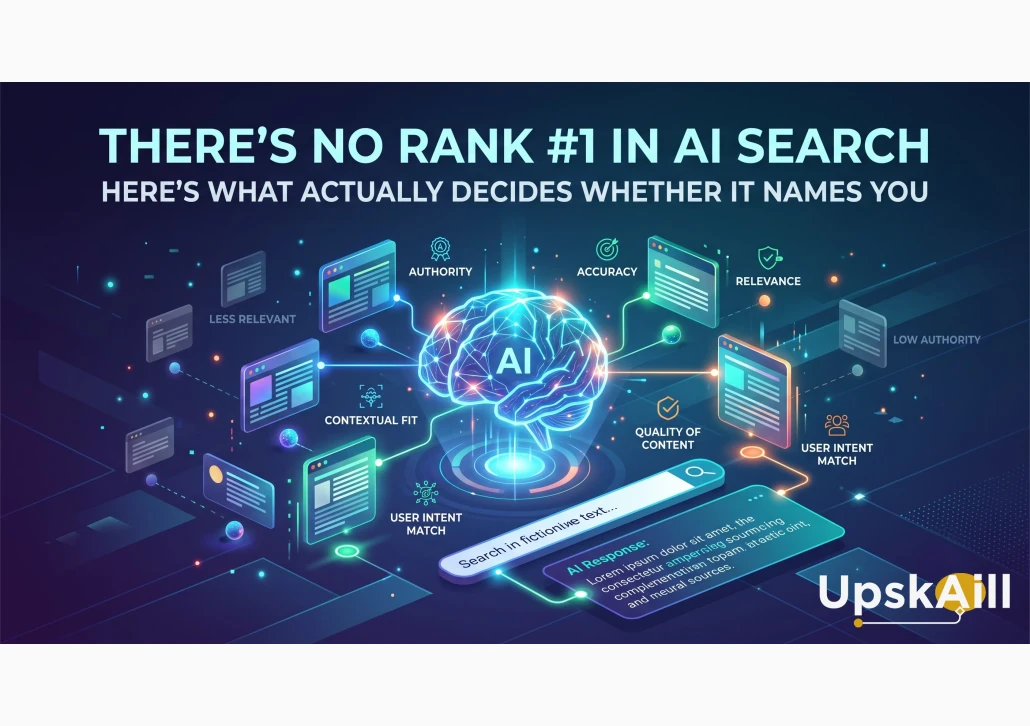
There is no "position one" in AI search. Ask ChatGPT the same question twice and you can get two different sets of brands. Ask it from London and then from Chicago and the answers drift again. So the thing a whole new industry is busy selling you, your "rank" inside AI, is mostly a fiction. And chasing it is one of the faster ways to waste a year of marketing budget.
That sounds like bad news for anyone trying to get found. It's actually the opposite, once you understand what replaced the ranking.
A new industry is selling you a number that doesn't exist
Over the past year, dozens of "AI rank tracking" and "AI visibility" tools have launched, each promising to tell you where you sit inside ChatGPT, Gemini, or Perplexity. Some are useful for spotting trends. Plenty are not: a common warning sign is a tool that hands you a confident "visibility score" but can't explain in plain language how that score is calculated. If nobody can tell you what the number measures, the number is decoration.
The deeper issue isn't the tools. It's that the thing they're trying to measure won't sit still. As one review of the category puts it, AI responses are non-deterministic and vary with prompt, context, and model updates. In practice that means a brand can show up in one answer and vanish from the next. One analysis found ChatGPT changed its cited sources 54.1% of the time on repeat queries. There is no stable ladder here to climb.
Why there's no ladder to climb
Google, for all its faults, gave you something fixed: an ordered list. Ten blue links, in a sequence, that you could work your way up. "Rank" made sense because the thing being ranked held still long enough to measure.
AI search doesn't give you a list. It gives you a sentence, written fresh each time, assembled from live web results and the model's own memory, then bent by your phrasing, your history, your location, and whichever version of the model happened to answer. Two people ask the same thing and get different names. There's no shared number one for anyone to own.
It gets messier. When researchers ran 1,600 queries through the major AI search tools, the engines failed to retrieve correct citation information more than 60% of the time. You are not optimising against a tidy index. You're dealing with a system that is still, often, unsure of its own sources.
So what actually decides whether AI names you?
Not a rank. Whether you are a clearly understood, well referenced entity that the wider web treats as credible on your subject. The question shifts from "how do I climb" to "am I known".
Here's the part most people miss. The model usually isn't reading your homepage and scoring it. It's synthesising what the rest of the internet says about you. That's why brands turn out to be roughly 6.5 times more likely to get cited through third-party sources than through their own domain. Your own site tells the model what you claim. Everywhere else tells it whether that claim is true.
There are really two layers working at once. One is the live web: get cited by a source the model pulls from, and you can start appearing in answers within days. The other is the model's memory, how it describes you from training with no search involved, which only shifts when the model is retrained. You earn your place in both the same way. By being genuinely, consistently referenced as a name that belongs in the answer.
The uncomfortable part, which is also the point
You can't buy your way to being the obvious answer, and you can't hack it either. It's earned: real authority, a clear identity the moment someone lands on you, and a credible footprint across the sources a model already trusts. That's slow, human work. A dashboard can show you the trend. It cannot manufacture the trust.
This is exactly why chasing tactics is a trap. Whatever trick reliably games this month's model tends to break on next month's. The durable skill isn't a checklist you follow, it's the judgement to understand your market, your buyers' actual questions, and how to become a source worth quoting. That judgement is the thing AI can't hand you, and it's the thing that keeps working after the tactics expire.
What to do instead
Stop reporting a phantom rank. Because a single check tells you almost nothing, measure the way the medium actually behaves:
- Run several real buyer questions, signed out, from your buyers' market, and repeat them over time. Watch the trend and your share of the answer, not one snapshot position.
- Put your effort into being referenced by the sources your buyers and the models already trust, rather than into gaming a score.
- Make your entity unmistakable. A stranger, human or machine, should be able to tell in seconds who you are and what question you're the answer to.
The brands that win AI search aren't gaming a system. There's no system to game. They're becoming the obvious answer, the name that keeps surfacing because it has earned the right to. That can't be bought in a tool. It has to be built. And if you're willing to do the real work, that's the best news in this whole shift, because most of your competitors are busy chasing a number that was never there.
UpskAill runs live, instructor-led cohorts on exactly this. In our AI Search Strategy (AEO/GEO) course you learn to measure your AI visibility honestly, without the phantom-rank theatre, and to build the genuine authority that earns the mention. See the current cohort.