
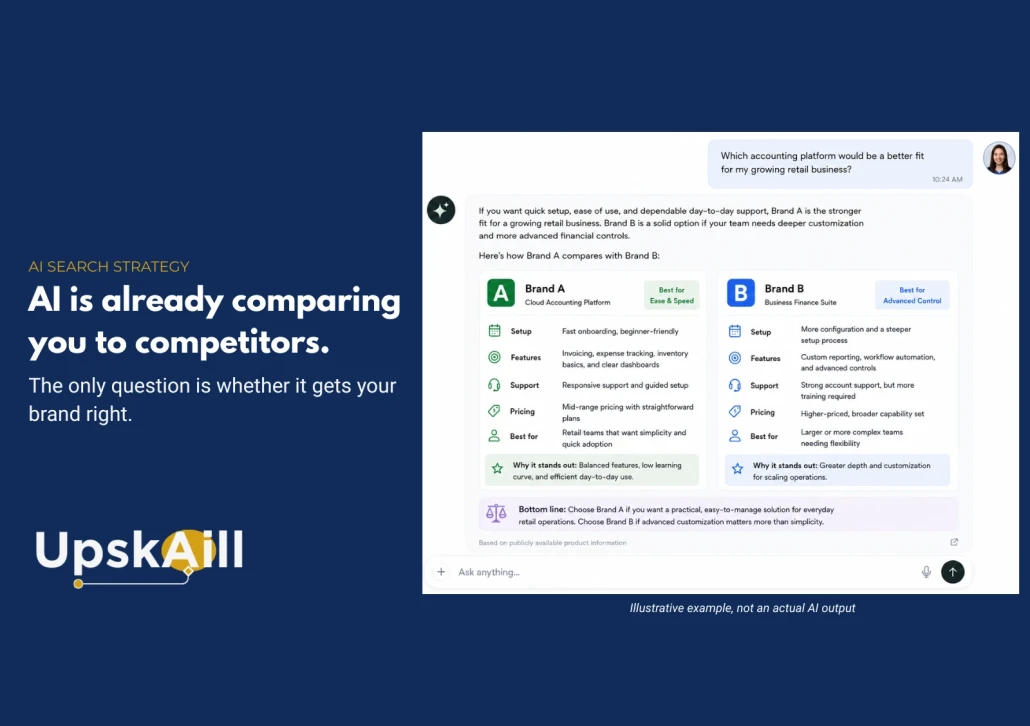
Much of the conversation around Answer Engine Optimization (AEO) and Generative Engine Optimization (GEO) has narrowed to one question: Did the AI engine cite us?
Yes, citations matter. They can tell us which sources an engine is drawing from, where authority may be coming from, and whether a brand's own content is finding its way into generated answers. But if citations become the whole objective, we risk optimizing for one visible feature of a much larger change in discovery.
The more important question is simpler:
What happens when someone asks an AI engine about your brand?
They might never ask for a source. They might never click a citation. They may simply ask whether your product is suitable for their situation, how you compare with a competitor, what your strengths and weaknesses are, or which provider they should shortlist.
That conversation can influence a decision before a traditional search-results page, website visit or sales conversation ever enters the journey.
Search is becoming a conversation, not just a list of results
For years, a typical research journey involved a sequence of searches. A buyer might search for a category, open several tabs, visit brand websites, read reviews, search for competitors, look for comparison pages and eventually assemble a view of the market themselves.
AI does not remove all of those behaviours. But it can compress much of the research into a conversation.
A customer can now ask something like: “I’m considering Brand A and Brand B for this use case. Compare them based on these three priorities, explain the trade-offs and tell me what I should investigate before choosing.”
The technology increasingly supports exactly this kind of interaction. OpenAI's current shopping research experience is designed around exploring products, comparing alternatives, weighing trade-offs and building a personalised buyer's guide. Google's AI search experiences similarly allow people to ask longer, more nuanced questions and refine them through follow-up queries.
This changes what “visibility” means. Visibility is no longer only occupying a position on a results page. A brand can become part of a generated comparison, recommendation or explanation without the customer following the familiar sequence of ten blue links.
The behavioural shift is already visible
Recent research gives us good reason to take this seriously without exaggerating the scale of the change.
Adobe surveyed more than 5,000 US consumers in 2025 and reported that 38% had already used generative AI for online shopping. Research was one of the leading uses, and among respondents who had used AI for shopping, 73% said it had become their primary source of product research.
Adobe's behavioural data also showed substantial growth in traffic from generative-AI sources to US retail websites. Importantly, Adobe noted that AI-referred shoppers were often using these systems during the research and consideration stage rather than simply arriving ready to buy.
More recent Gartner research adds an important qualification. Its 2026 US consumer research suggests people are more comfortable asking AI to help with research, comparisons and narrowing choices than handing the final purchasing decision to the machine.
That distinction matters.
The opportunity for brands is not based on the assumption that everyone will ask an AI agent to buy something autonomously. The more immediate change is that AI can sit between the customer's question and the customer's decision.
Your brand can matter in an AI answer without receiving a citation
Imagine a prospective customer already knows your name.
They are not asking, “What are the best companies in this category?” They ask, “Is Brand X a good choice for a company like mine?”
Or they ask, “Brand X versus Brand Y: which would be better if my priority is implementation support?”
In those situations, appearing as a citation is not the only issue. The customer is asking the engine to interpret your brand.
Does it understand what you do? Does it represent your positioning accurately? Does it associate you with the problems you actually solve? When it compares you with competitors, does the comparison reflect reality? Is there enough accessible, credible information for the engine to construct a useful answer at all?
A brand could therefore have an AI-search problem even when a citation dashboard looks healthy. Equally, it could have meaningful visibility in customer conversations that a citation-only metric fails to capture.
Citations are evidence, they are not the whole strategy.
None of this makes citation analysis less valuable.
Understanding which sources are shaping generated answers can reveal a great deal. It can show whether an engine is relying on your website, third-party publications, reviews, directories, community discussions or other sources when forming its response.
That makes citations useful diagnostic evidence.
But the next question should be: What answer is that evidence helping the engine construct?
A brand can be cited and still be represented poorly. A competitor can be recommended more strongly. Important differentiation can disappear. Outdated information can dominate the answer or the engine may know the brand exists but fail to connect it with the use case the customer actually cares about.
Those are strategy problems, not simply citation problems.
Audit the questions customers might actually ask
A useful AEO/GEO exercise therefore starts before counting citations.
Ask the engines about your brand in realistic customer contexts. Ask what your company does and who it is suited to. then compare your brand with a real competitor. Finally, introduce the constraints a buyer might use when making a decision and see how the answer changes.
Do this across more than one engine. Generated responses are not fixed search rankings, and different systems can surface different information, sources and interpretations.
Then investigate the gaps. If an answer is weak, incomplete or inaccurate, the useful question is not simply, “How do we make AI mention us more?” It is, “Why is this the information the engine can currently find, understand and trust enough to use?”
That opens a much more useful discussion about brand clarity, content architecture, entity information, authority, third-party evidence and the sources shaping how the organisation is understood.
AEO/GEO should follow the customer journey, not the latest metric
AI search technology will keep changing. Interfaces will change, models will change, citation formats will change and new discovery as well as commerce features will appear.
A strategy built entirely around one current interface behavior is therefore fragile.
The more durable objective is to make sure that when a prospective customer brings your brand into an AI-assisted research journey, the engine has enough clear, credible information to construct a useful answer.
This is also why UpskAill's AI Search Strategy training goes beyond trying to “get cited.” Participants audit how their own brands appear across answer engines, examine the sources shaping those answers, identify visibility and representation gaps, and turn those findings into a prioritised AEO/GEO strategy.
Because the customer may never ask an AI engine to show its citations.
They may simply ask:
“Should I consider this brand?”
And increasingly, that is an answer worth paying attention to.